Research
Physical networks
Physical networks
Network models for systems whose nodes and edges are tangible objects embedded in space and constrained by volume and geometry.
Multi-scale organization
Fractal scale-free networks
Bifractality and diffusion in networks that are simultaneously scale-free and fractal.
Higher-order dynamics
Triadic interactions
Stochastic diffusion dynamics on networks in which a node can activate or inhibit an edge between two other nodes.
Physical networks
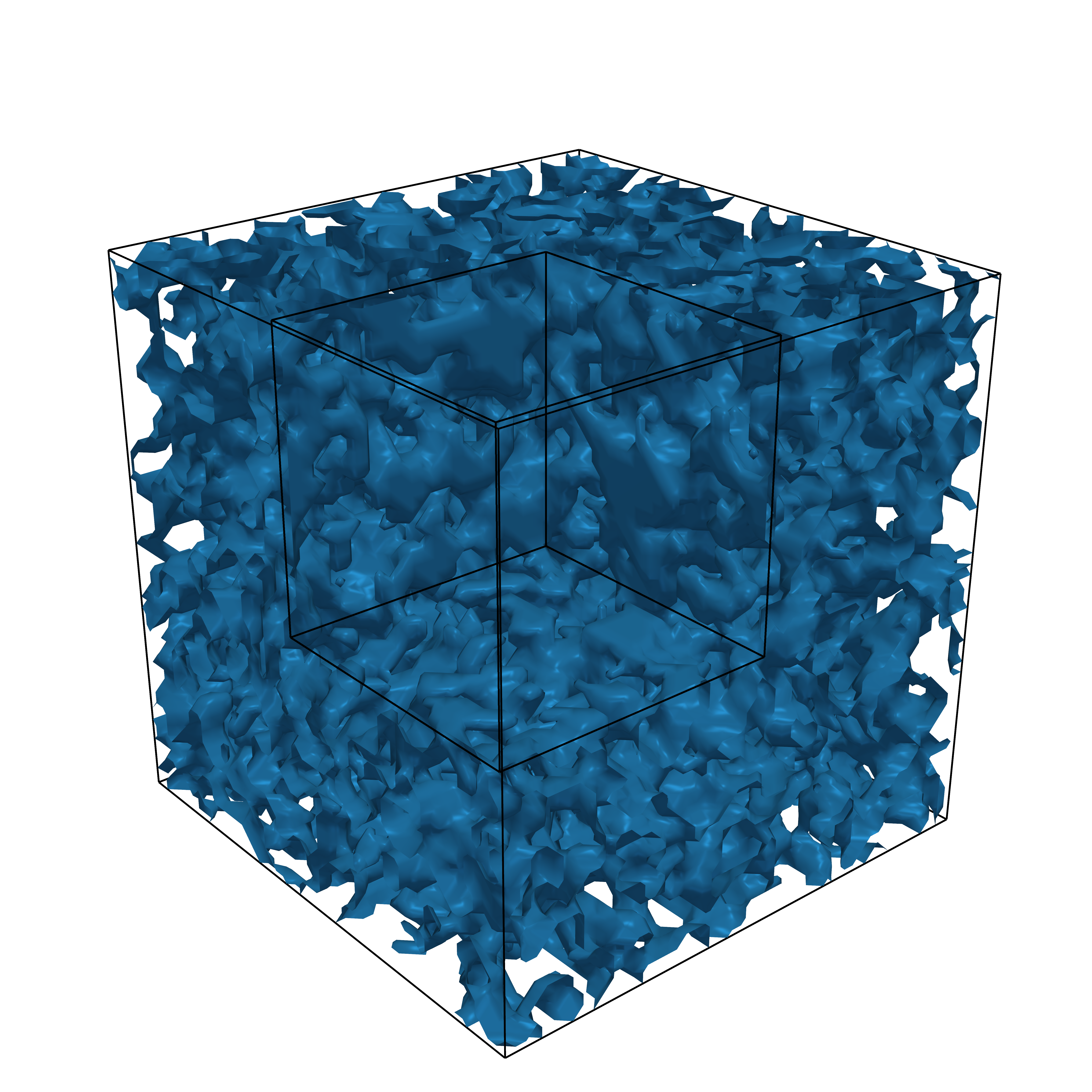
Physical networks are networks of tangible components, in which nodes and edges are embedded in physical space and subject to volume exclusion (Dehmamy, Milanlouei, and Barabási 2018). Examples include biological neural networks, vascular systems, porous media, and granular materials.
Advances in imaging technologies and accelerated three-dimensional reconstruction by AI/ML have made detailed empirical maps of these systems increasingly accessible. This creates an opportunity to develop new theoretical frameworks for incorporating physicality into abstract network models and to understand how physical constraints reshape network structure and dynamics.
The physical layout of networks has been shown to give rise to structural features such as entanglement (Liu, Dehmamy, and Barabási 2021; Glover and Barabási 2024), bundling (Bonamassa et al. 2025), jamming (Pósfai et al. 2024), and correlations between node degree and node volume (Pete et al. 2024; Piazza et al. 2025). However, it remains less explored how these constraints affect diffusion, synchronization, and other dynamical processes.
Laplacian localization
As an analytical model of dynamics on physical networks, we study a multi-scale diffusion dynamics on a network-of-networks representation of physical networks (Pete et al. 2024). In the weak inter-subnetwork coupling limit (relative to the intra-subnetwork coupling), the relevant operator reduces to a node-weighted Laplacian for physical networks,
\begin{equation} \mathbf{Q}_{\mathrm{P}} = \mathbf{V}^{-1/2} \mathbf{Q}_{\mathrm{G}} \mathbf{V}^{-1/2}, \end{equation}
where \mathbf{Q}_{\mathrm{G}} is the combinatorial graph Laplacian of the inter-subnetwork edges and \mathbf{V}=\mathrm{diag}(v_1,\dots,v_N) is the diagonal matrix of node volumes (subnetwork sizes).
We study eigenmode localization of this operator and identify how node physicality reshapes the localization phenomena in physical networks.
More coming soon…
Modular synchronization
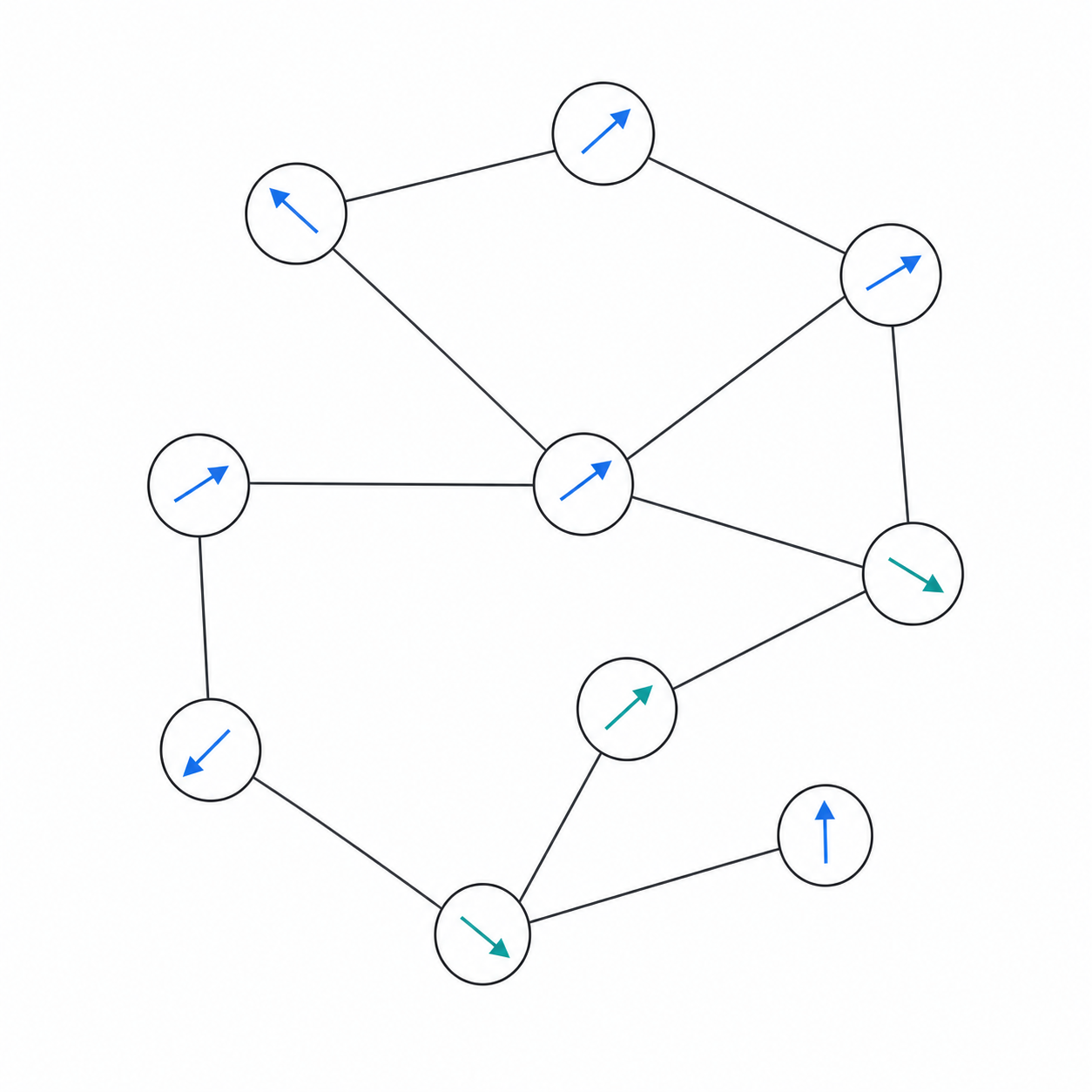
Motivated by the coarse-grained Laplacians that arise in the weak-subnetwork coupling limit of diffusions on a network-of-networks, we study modular synchronization dynamics in heterogeneous modular networks. As demonstration, we are working in collaboration with an experimental group to design and test modular synchronization in a physical network of coupled spin-Hall nano-oscillators.
More coming soon…
Fractal scale-free networks
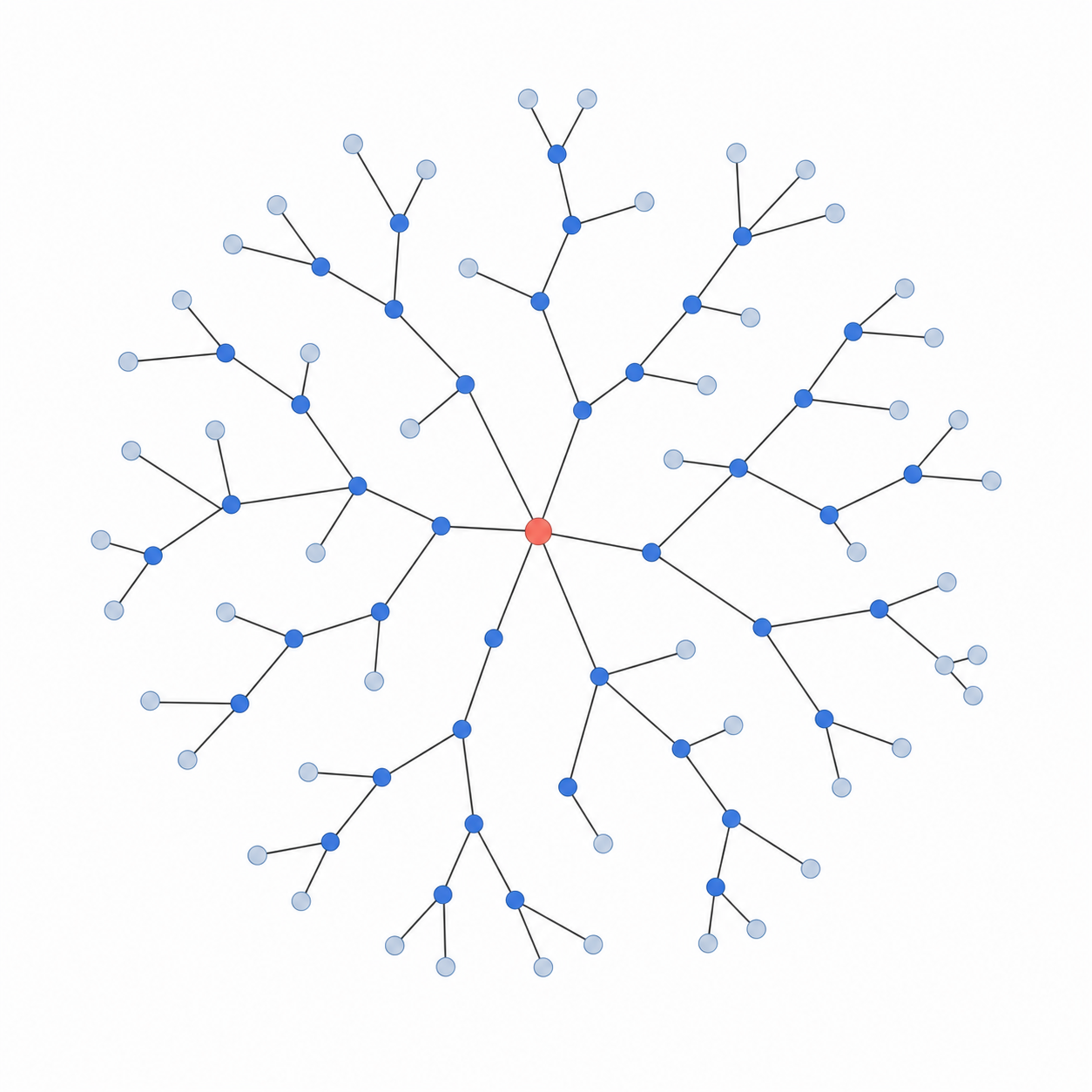
A network is fractal with respect to shortest-path lengths if the minimum number of subgraphs, or boxes, of diameter l_{\mathrm{B}} required to cover the network scales as
\begin{equation} N_{\mathrm{B}}(l_{\mathrm{B}})\sim l_{\mathrm{B}}^{-D_{\mathrm{f}}}, \end{equation}
where D_{\mathrm{f}} is the fractal dimension (Song, Havlin, and Makse 2005). In fractal networks, average path lengths scale as a power of the network size,
\begin{equation} \langle l\rangle\sim N^{1/D_{\mathrm{f}}}. \end{equation}
in contrast to small-world networks with logarithmic scaling.
Fractal network models are useful as analytical models for renormalization and coarse-graining because they exhibit well-defined structural scale-invariance, and long-range degree correlations in fractal networks allow analytical studies of their implications.
Bifractal property
For a class of fractal scale-free networks in which, under renormalization, the number of nodes \nu_{\mathrm{B}} in a supernode (node after coarse-graining) of diameter l_{\mathrm{B}} is proportional to the degree k_{\mathrm{B}} of that supernode:
\begin{equation} \nu_{\mathrm{B}}\propto k_{\mathrm{B}}, \end{equation}
the network exhibits two local fractal dimensions,
\begin{equation} d_{\mathrm{f}}^{\max}=D_{\mathrm{f}},\qquad d_{\mathrm{f}}^{\min}=D_{\mathrm{f}}\left(\frac{\gamma-2}{\gamma-1}\right), \end{equation}
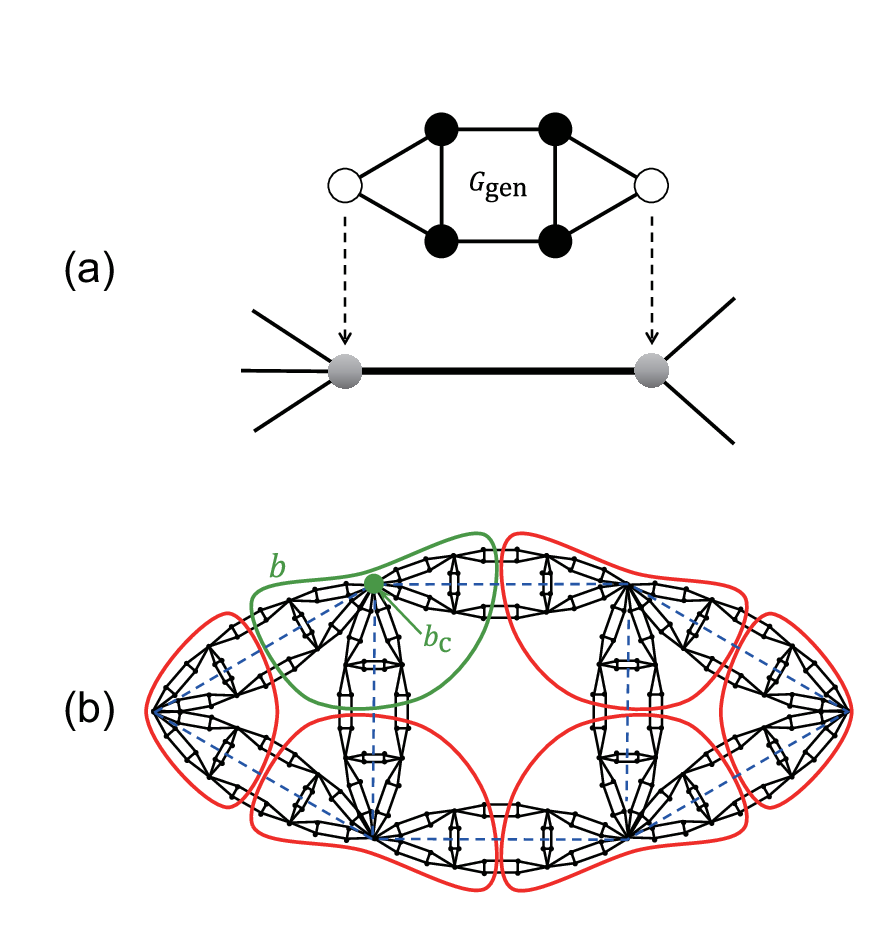
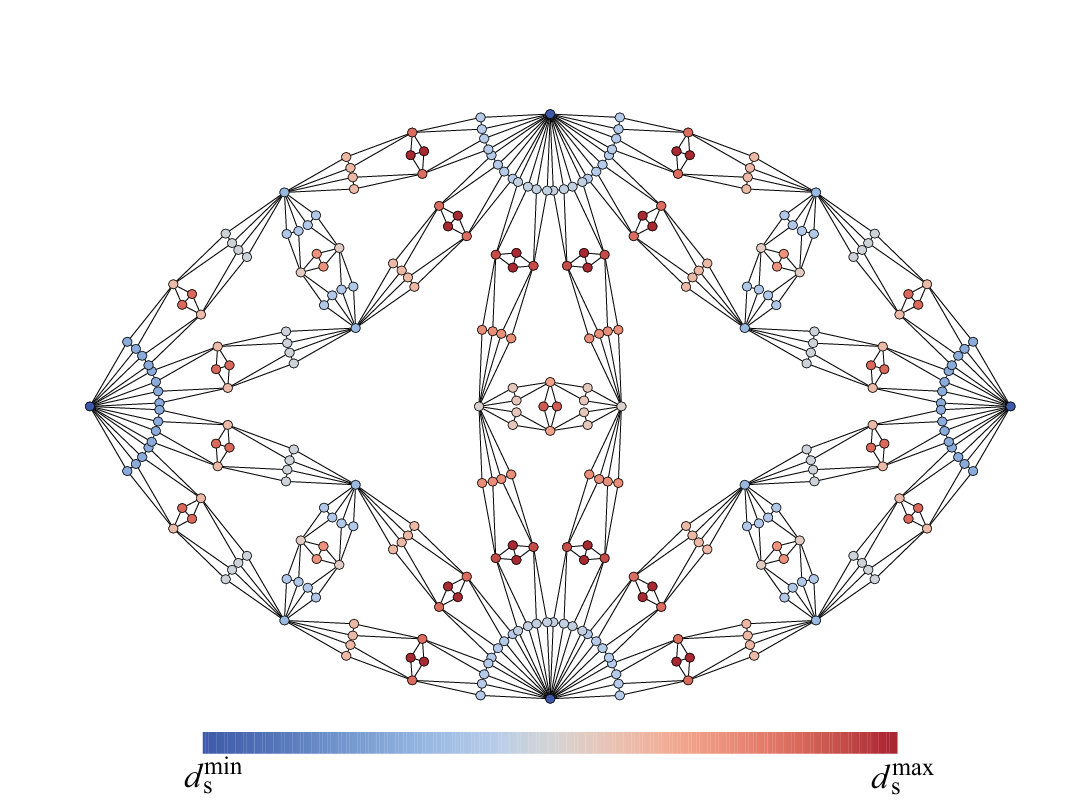
where \gamma is the exponent of the degree distribution and D_{\mathrm{f}} is the (box-covering) fractal dimension. The minimum local fractal dimension d_{\mathrm{f}}^{\min} is associated with the neighborhood of the hub nodes, while the maximum local fractal dimension d_{\mathrm{f}}^{\max} is associated with the neighborhood of non-hub nodes. Analytical and numerical calculations for deterministic and stochastic hierarchical fractal scale-free networks, together with fractal scale-free random graphs, suggest that bifractality is a general property of fractal scale-free networks (Yamamoto and Yakubo 2023).
Random walks in bifractal networks
Building on the bifractality conjecture, we studied random walks on bifractal networks and found that the walk dimension remains position-independent, whereas the spectral dimension splits into two local values, reflecting the underlying bifractal structure (Yakubo, Shimojo, and Yamamoto 2024).
Higher-order networks with triadic interactions
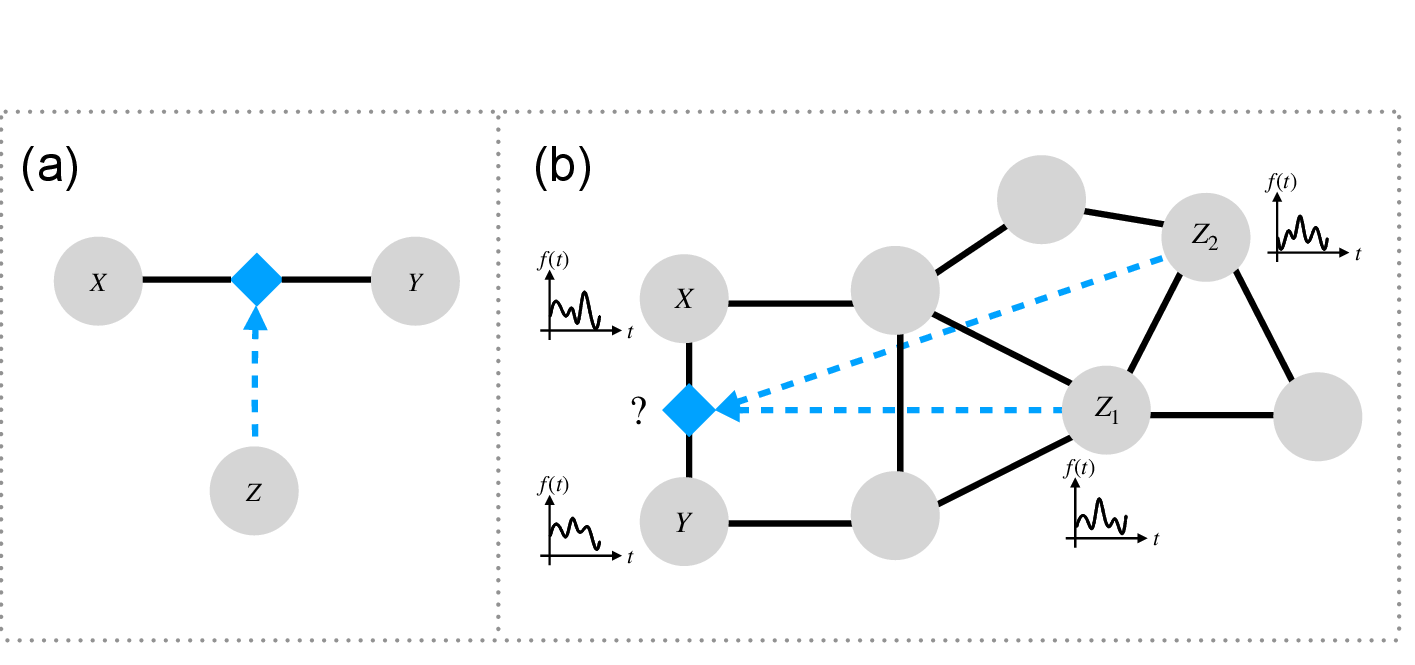
Triadic interactions are higher-order, three-body interactions in which a node modulates an edge between two other nodes. Such interactions are reported in real systems; for example, glial cells can regulate synaptic interactions between neurons, and a third species can interfere with pairwise ecological interactions (Wang et al. 2009; Cho, Barcelon, and Lee 2016; Grilli et al. 2017; Li et al. 2026).
To model such interactions, we define a triadic interaction on a network G=(V,E) as an interaction between a node i\in V and an edge \ell\in E, encoded by an incidence matrix \mathbf{K}\in\{-1,0,1\}^{|E|\times |V|} with entries
\begin{equation} K_{\ell i} = \begin{cases} -1, & \text{if node } i \text{ inhibits edge } \ell,\\ 1, & \text{if node } i \text{ activates edge } \ell,\\ 0, & \text{otherwise}. \end{cases} \end{equation}
Signed triadic interactions turn percolation processes into dynamical ones and can induce phenomena such as period doubling and chaos (Sun et al. 2023; Sun and Bianconi 2024; Millán et al. 2024).
In my MSc dissertation and the subsequent collaborative work, I studied Langevin dynamics on networks with triadic interactions, where the interaction matrix coevolves with node states through a triadic Laplacian. The model takes the form
\begin{equation} d\mathbf{X}=-(\mathbf{L}^{(\mathrm{T})}+\alpha\mathbf{I})\mathbf{X}\,dt+\mathbf{\Gamma}\,d\mathbf{W}_t, \end{equation}
where \mathbf{L}^{(\mathrm{T})} is a state-dependent triadic Laplacian. The pairwise baseline without triadic interactions is analytically tractable, while triadic interactions produce conditional statistical signatures. The results show that conditional correlations and conditional mutual information can reveal the existence, sign, and strength of triadic interactions. This framework was used as a null model to identify potential triadic interactions in gene regulatory networks (Niedostatek et al. 2025).